(Fidelity and Loyalty as Paths to Kung Fu)
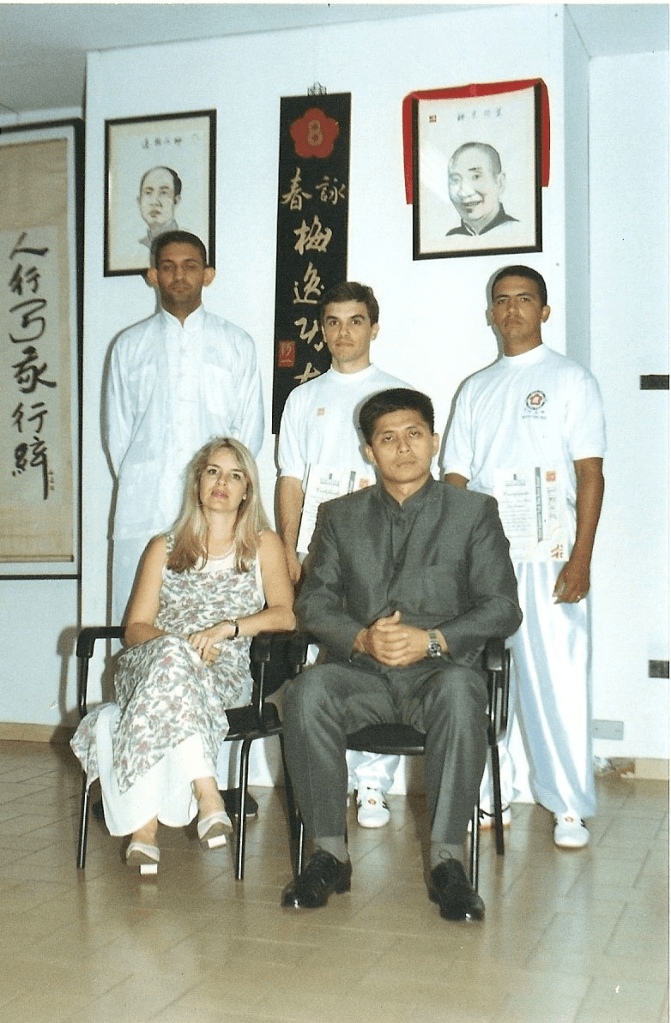
(Record of the First Access to the Final Senior Level in the History of the Moy Yat San Family in 1998. Those Promoted Were Masters Renato Almeida, Nataniel Rosa, and Julio Camacho.)
Considerando a etimologia das palavras fidelidade e lealdade, temos:
Fidelidade:
A palavra “fidelidade” vem do latim fidelitas, que deriva de fidelis, significando “fiel” ou “leal”. O prefixo “fid-” está relacionado à ideia de confiança e confiança mútua.
Fidelis (latim) significa “fiável”, “leal”, “que guarda a fé” e está relacionado à palavra fides, que significa “fé” ou “confiança”.
Lealdade:
A palavra “lealdade” vem do latim legitimitas, que deriva de legitimare, significando “tornar legítimo” ou “agir de acordo com a lei”. Nesse contexto, lealdade tem uma conotação de agir com retidão, respeitando uma norma ou um compromisso.
Ao longo do tempo, o termo passou a ser associado à ideia de agir com fidelidade, honra e compromisso, principalmente em relação a uma pessoa, grupo ou causa.
Sempre achei essas palavras semelhantes em seu significado e, de fato, são. A diferença está na adequação de seu uso. Enquanto a palavra fidelidade é direcionada aos pares, lealdade é dedicada àqueles que ocupam posições de liderança ou chefia e, por isso, possuem funções, percepções e responsabilidades diferentes.
(Considering the etymology of the words fidelity and loyalty, we have:
Fidelity:
The word “fidelity” comes from the Latin fidelitas, which derives from fidelis, meaning “faithful” or “loyal.” The prefix “fid-” is related to the idea of trust and mutual confidence.
Fidelis (Latin) means “trustworthy,” “loyal,” or “one who keeps faith” and is connected to the word fides, which means “faith” or “trust.”
Loyalty:
The word “loyalty” comes from the Latin legitimitas, which derives from legitimare, meaning “to make legitimate” or “to act in accordance with the law.” In this context, loyalty carries a connotation of acting with integrity, respecting a norm or commitment.
Over time, the term became associated with the idea of acting with fidelity, honor, and commitment, especially toward a person, group, or cause.
I’ve always found these words similar in meaning, and indeed, they are. The difference lies in their appropriate usage. While the word fidelity is directed toward peers, loyalty is dedicated to those in leadership or authority positions, who, as a result, have different roles, perspectives, and responsibilities.)

(Practice of the Traditional Program, 2024)
O exemplo que mais deixa clara essa diferença, em minha opinião, é a família Kung Fu, já que temos nosso mentor e, portanto, nossa referência no desenvolvimento da experiência marcial, e nossos irmãos Kung Fu, que são pessoas que compartilham o caminho.
A figura do Si Fu é única e imutável. Portanto, ele ou ela, no caso dela, a Si Fu, possui a responsabilidade e condições totais de guiar seus discípulos. Já os companheiros de prática, sendo este mais velho ou jovem, têm o dever de compartilhar a experiência marcial que tiveram com os demais como uma inspiração e, sobretudo, com a responsabilidade de entender que sua maneira de aprender é única e pessoal. Assim como tiveram essa oportunidade, os demais também têm esse direito.
(The example that, in my opinion, most clearly illustrates this difference is the Kung Fu family, as we have our mentor and, therefore, our reference in the development of the martial arts experience, as well as our Kung Fu brothers and sisters, who are people sharing the same path.
The figure of the Si Fu is unique and unchanging. Therefore, he or she (in her case, the Si Fu) has the full responsibility and capability to guide their disciples. On the other hand, practice companions, whether older or younger, have the duty to share their martial arts experience with others as a source of inspiration and, above all, with the responsibility of understanding that their way of learning is unique and personal. Just as they had this opportunity, others also have this right.)

(Disciples of the Moy Jo Lei Ou family gathered on the occasion of the Chinese New Year celebration, 2020.
Let me know if you need anything else!.)
Essa reflexão surgiu em determinado momento em que estava no Mo Gun com diversos praticantes. Estávamos cuidando do nosso espaço e, naquela ocasião, eu era o mais antigo. Imbuído do dever que tinha assumido para mim, apesar de ninguém definitivamente me direcionar, achei por bem pontuar eventuais falhas dos demais. Em dado momento, chamei a atenção de um companheiro, já que ele havia se distraído e deixado a luz do banheiro acesa, além de ter se esquecido de fechar a torneira da pia. Logo em seguida, percebi outras falhas e continuei pontuando até o momento em que percebi ter deixado transbordar um copo que enchia com água.
Minha distração não causou nenhum prejuízo, e rapidamente corrigi o erro, mas foi ótimo que tenha acontecido, pois percebi que estava no automático, apesar de ter uma postura travestida de Kung Fu, isto é, querer ensinar ao outro. De fato, Kung Fu não se ensina, se aprende.
É comum, quando se é mais antigo e na ausência do Si Fu, assumirmos responsabilidades pelos demais. Esse cenário é extremamente complexo. Posso citar momentos em que, sem perceber, tomei minha relação com Si Fu como o eixo de todo e qualquer contato e, dessa forma, ilegitimamente, assumi o papel de Si Fu para meus contemporâneos. Assim não funciona. A verdade é que somos alunos a vida toda e apenas uma parte dela também somos mestres.
Dessa forma, a melhor maneira de orientar meus pares é sendo o mais honesto possível, fiel a eles e, sobretudo, leal ao meu Si Fu. No caso da lealdade, a razão é muito simples: desde muito jovem aprendi que, independentemente da situação, é preciso não deixar de honrar um único compromisso, que é o de aprender sempre.
Por isso, a partir daquele dia, me policio para, em vez de dizer o que o outro deve fazer, procurar eu próprio fazer. Dessa forma, não estou ensinando, mas aprendendo, e o compromisso do outro em levar ou não adiante é uma questão particular; depende do Kung Fu de cada um.
Quanto ao papel de mestre, não sei como é. Apesar do título, isso ainda não me aconteceu.
(This reflection arose during a specific moment when I was at the Mo Gun with several practitioners. We were taking care of our space, and on that occasion, I was the most senior. Filled with the duty I had assumed for myself—even though no one had explicitly directed me to do so—I thought it appropriate to point out occasional mistakes made by others. At one point, I called out a companion because he had gotten distracted, left the bathroom light on, and forgotten to turn off the sink faucet. Soon after, I noticed other mistakes and continued pointing them out until I realized I had let a cup I was filling with water overflow.
My distraction didn’t cause any harm, and I quickly corrected the mistake, but it was great that it happened because I realized I was on autopilot, despite having a posture disguised as Kung Fu—that is, wanting to teach others. In reality, Kung Fu is not taught; it is learned.
It’s common, when you’re more senior and in the absence of the Si Fu, to take on responsibilities for others. This scenario is extremely complex. I can recall moments when, without realizing it, I took my relationship with the Si Fu as the axis of every interaction and, in doing so, illegitimately assumed the role of Si Fu for my peers. That’s not how it works. The truth is, we are students for life, and only for a part of it are we also masters.
Therefore, the best way to guide my peers is by being as honest as possible, faithful to them, and, above all, loyal to my Si Fu. In the case of loyalty, the reason is very simple: from a very young age, I learned that, regardless of the situation, one must never fail to honor a single commitment, which is to always learn.
For this reason, from that day on, I’ve made an effort to, instead of telling others what they should do, focus on doing it myself. In this way, I’m not teaching but learning, and the commitment of others to carry it forward or not is a personal matter; it depends on each one’s Kung Fu.
As for the role of a master, I don’t know what it’s like. Despite the title, that hasn’t happened to me yet.)
 Escritos Marciais