(Art as an Expression of Humanity)
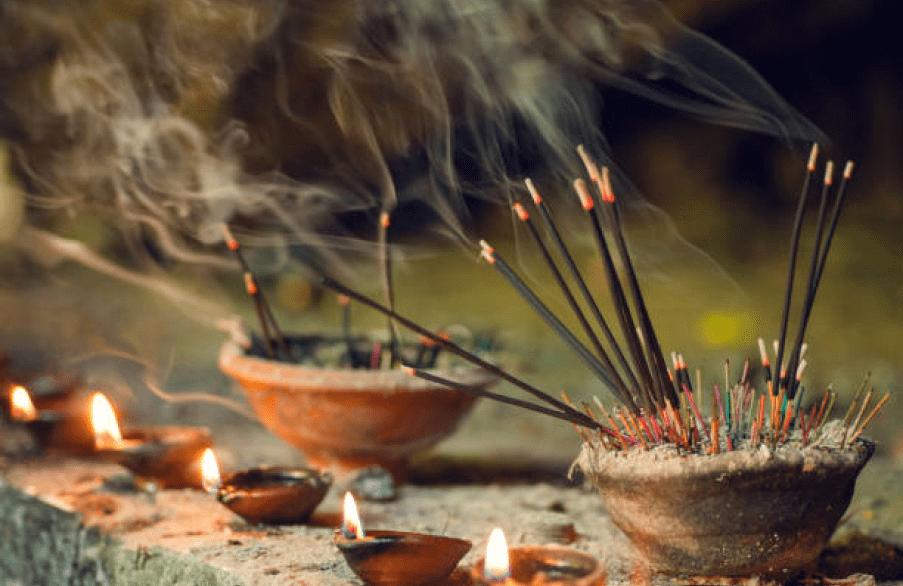
Incense Represented as Cultural Formation
Cada cultura tem particularidades que são baseadas em uma série de confirmações históricas. Além da história, que, em geral, se refere ao que já passou, é importante entender a conjuntura atual do mundo, já que isso influencia e, eventualmente, até mesmo atualiza qualquer que seja a base de qualquer tradição. Aliás, cabe lembrar: o que é tradicional não necessariamente é antigo, apenas se refere ao que foi passado adiante pelos detentores do saber. E, sobre a história, saibamos: neste exato momento, estão sendo construídas diversas histórias. Esta preleção é relevante, pois explica que nenhum conhecimento é absoluto ou de determinada cultura; muito pelo contrário, todo patrimônio deve ser considerado um bem da humanidade.
(Every culture has particularities that are based on a series of historical confirmations. Beyond history, which generally refers to what has already passed, it is important to understand the current state of the world, as this influences and sometimes even updates the foundation of any tradition. Moreover, it is worth remembering: what is traditional is not necessarily ancient; it simply refers to what has been passed down by the holders of knowledge. And about history, let us know: at this very moment, many stories are being built. This discourse is relevant because it explains that no knowledge is absolute or belongs to a specific culture; on the contrary, all heritage should be considered a asset of humanity.)
Com relação à humanidade, pela minha cultura de berço, aprendi que significava ser bom e justo. Me aprofundando na vida, ou seja, ficando mais velho, e acessando outros saberes, percebi que a humanidade pode significar a interação entre pessoas, no mínimo duas; o que quer dizer que um ser humano é a pessoa que se relaciona com outro indivíduo, que pode ser considerado, em si, bom ou mau. Neste caso, não importa a característica pessoal, mas sim a relação. Pessoalmente, considero que, para uma relação fluir, é necessário empenho de ambas as partes; ou seja, se bem trabalhada, a relação humana promove o desenvolvimento.
(Regarding humanity, from my upbringing, I learned that it meant being good and just. As I delved deeper into life, that is, as I grew older and accessed other forms of knowledge, I realized that humanity can mean the interaction between people, at least two; which means that a human being is someone who relates to another individual, who may be considered, in themselves, good or bad. In this case, personal characteristics do not matter, but rather the relationship. Personally, I believe that for a relationship to flow, effort from both sides is necessary; in other words, if well nurtured, human relationships promote development.)
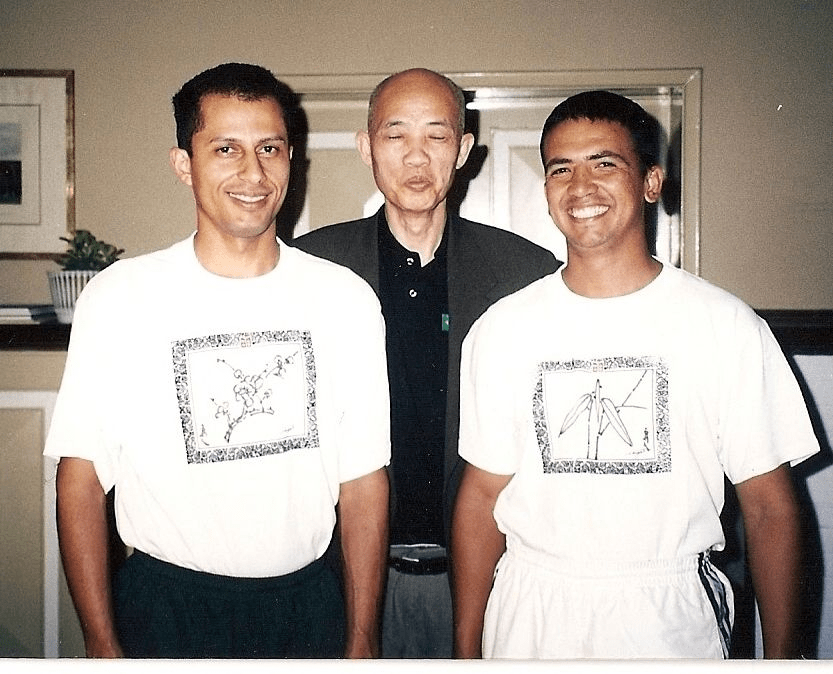
Patriarch Moy Yat and Masters Julio Camacho and Marcelo Abreu, 1998.
Essa reflexão surge de uma história que meu Si Fu me contou a respeito de um presente recebido do patriarca Moy Yat. Aliás, não apenas ele, mas também meu Si Suk, Marcelo Abreu o receberam. A justificativa para o presente foi a dedicação de ambos em fazer com que determinado evento acontecesse no ano de 1998. Na época, Si Taai Gung Moy Yat disse: “Quem trabalha mais merece mais.” O presente consistia em duas camisas pintadas por ele, exatamente as camisas da foto, onde estão desenhadas uma flor de ameixeira e um bambu. Considerando a mestria do patriarca Moy Yat na pintura, podemos imaginar a alegria e a honra de receber um presente criado especialmente para eles.
(This reflection stems from a story that my Si Fu told me about a gift received from Patriarch Moy Yat. In fact, not only him but also my Si Suk, Marcelo Abreu. The justification for the gift was the dedication of both in making a certain event happen in 1998. Si Taai Gung Moy Yat, at the time, said: “Those who work more deserve more.” The gift consisted of two shirts painted by him, exactly the shirts in the photo, which feature a plum blossom and a bamboo. Considering Patriarch Moy Yat’s mastery in painting, we can imagine the joy and honor of receiving this gift, painted especially for them.)
O que mais me chama atenção nesta história é a questão do trabalho. Perceba: eles trabalharam muito para fazer o evento acontecer, e isso, por si só, já tem mérito. Contudo, o principal trabalho foi o exercício da humanidade que ambos desenvolveram. Por isso, o comentário de Si Taai Gung: “Ameixeira e bambu, sempre amigas, sempre juntas.” Creio que qualquer relação acontece através do investimento contínuo e trabalhoso da humanidade entre dois indivíduos.
(What stands out to me most in this story is the issue of work. Notice: they worked hard to make the event happen; that, in itself, is commendable. However, the main work was the exercise of humanity that both developed. That is why Si Taai Gung’s comment: “Plum blossom and bamboo, always friends, always together.” I believe that any relationship happens through the continuous and laborious investment of humanity between two individuals.)
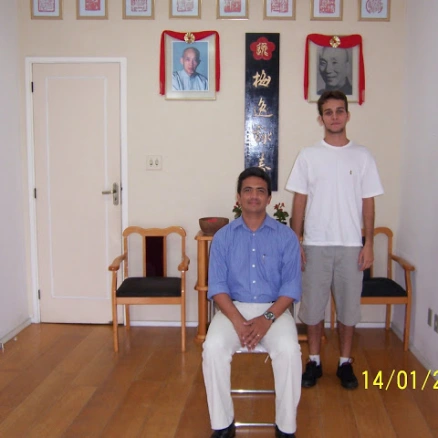
Traditional photograph between master and disciple, 2008.
Ser capaz de avaliar saberes de outras culturas e se apropriar deles, tornando-os próprios, me parece uma habilidade específica dos artistas. Inclusive, no caso do incenso, o caráter simbólico que mais aprecio é sua capacidade de se espalhar pelo ambiente, simbolizando o conhecimento que deve estar disponível em absoluto para todos que desejarem. Com meu Si Fu, aprendo a cada dia. Há saberes aos quais tive muito acesso e já assumi para mim, e outros que preciso desenvolver. De todo modo, há sempre uma escolha. O que posso afirmar é que, como “tradere”, ou seja, tradição, tudo foi entregue. Mas nada especificamente para mim; está disponível no ar. Cabe a mim a responsabilidade de acessar ou não, conforme minha capacidade.
(Being able to evaluate knowledge from other cultures and appropriate it, making it your own, seems to me a skill specific to artists. Even in the case of incense, the symbolic character I most appreciate is its ability to spread through the environment, symbolizing knowledge that should be absolutely available to all who seek it. With my Si Fu, I learn every day. There are forms of knowledge to which I have had much access and already embraced, and others I need to develop. In any case, there is always a choice. What I can affirm is that, as “tradere,” that is, tradition, everything has been handed down. But nothing specifically for me; it is available in the air. It is my responsibility to access it or not, according to my capacity.)
Em minha titulação, Si Fu frisou em seu texto um aforismo bastante especial em nossa família: “Sigamos juntos.” Mas, mais do que reproduzir as palavras, como é comum em nossa cultura, ele destacou seu desejo de que sigamos juntos os que verdadeiramente desejarem. Isso ressoou de maneira especial para mim. Seguir junto passou a ser não apenas um desejo expresso, mas uma necessidade constante de conexão e trabalho. A isto se reflete o desejo.
(In my graduation, Si Fu emphasized, in his text, a very special aphorism in our family. Let us follow it together. But more than just reproducing the words, as is common in our culture, he emphasized his desire for us to follow together, adding: “those who truly wish to.” This is, in a very special way, meaningful to me. Following together has become not only an expressed desire but a constant need for connection and work. This is what the desire refers to.)
De toda forma: “Quem trabalha mais merece mais.” Considerando que meu desejo é honrar minha ancestralidade, posso afirmar que sim, seguiremos juntos. Quanto ao merecimento, nada me é mais valioso do que aquilo que a vida Kung Fu já me proporcionou: a possibilidade de verdadeiramente construir uma vida baseada em meus valores, que são refinados a todo momento.
(In any case: “Those who work more deserve more.” Considering that my desire is to honor my ancestry, I can affirm that yes, we will follow together. As for deserving, nothing is more precious to me than what has already been provided to me through life in Kung Fu, which is the possibility of truly building a life based on my values, which are refined all the time.)
 Escritos Marciais